

Women Without Men: thoughts
book review of the Booker International long listed novel that unsettles the idea of freedom

The International Booker longlist finally made me pick up Women Without Men by Shahrnush Parsipur - a novel I’d been meaning to read for years. I’d heard it was banned in Iran, that Parsipur was imprisoned for writing it, so I had certain expectations going in: something defiant. Women finding each other, finding freedom. Collective, hopeful.
It isn’t quite that.
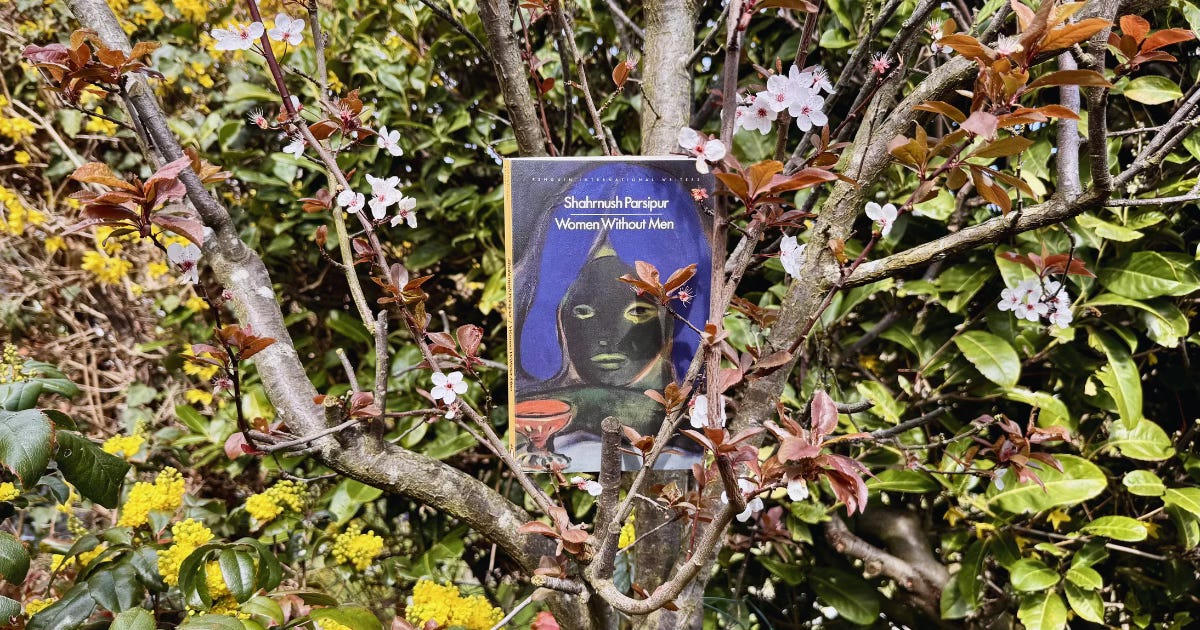
The novella follows five women in Tehran in 1953 - the year of the US and UK-backed coup d’état that toppled Iran’s democratic government. The political collapse runs alongside the personal ones: each woman, arriving from a different corner of Iranian society, is in the process of breaking from the life that has been arranged around her. They all meet, eventually, in a garden outside Tehran and live there for a while, without men.
Sparse, almost affectless - violence and tenderness delivered in the same flat register. One woman is killed - more than once. Another plants herself in the ground and begins to turn into a tree. Another sleeps with headless men. Parsipur doesn’t linger on any of it. The casualness feels deliberate: this is simply the texture of these women’s lives - the mundane and the unbearable sitting side by side.
I spent a while trying to decode the magical elements - the woman who becomes a tree, the one who dies and keeps returning. Eventually I stopped trying when I accepted that they don’t seem to work as symbols with clean meanings. They feel more like what happens when a life becomes so constrained that ordinary logic can no longer hold it. The magic isn’t liberation - it’s a portrait of the breaking point.
I expected the garden to be the hopeful part. For a moment it feels like it might be - a life outside the structures that have defined these women, a kind of sanctuary. But the woman who owns the garden tolerates them rather than welcomes them. Fa’iza, who arrives with her closest friend, remains oddly indifferent - to the other women, and to her friend too, even after everything they’ve been through together. The woman who became a tree simply stands there, resolute, contributing nothing - or perhaps that’s the point. They don’t build anything together. They simply occupy the same space for a time and then they leave, back into their various fates, not obviously changed.
I’m not sure whether that’s the novel’s most honest gesture or its most unresolved one.
A lot of the conversation around this book centres on how transformative this book is being passed hand to hand in secret. And whilst that matters, of course it does, I do think that narrative has become a way of not quite reading the book - as though its significance is settled by the conditions of its making rather than by what it does on the page. Courage and literary achievement aren’t quite the same thing, even when they arrive together.
Reading it from London, I kept thinking about how the forces the novel describes - control, diminishment, women’s lives shaped entirely around other people’s needs - aren’t absent here. They just operate differently. Parsipur’s world makes certain things visible precisely because they are named, almost accepted as a way of being, impossible to look away from. Which made me wonder what becomes harder to see in the gaps.
Parsipur isn’t writing a document of a particular time and place. She’s writing about what it costs to live inside a world that wasn’t built for you - and about how difficult it is to imagine freedom when you’ve never really been shown what it looks like.
Maybe the promise of the garden doesn’t hold because it was never meant to.
✨ If this piece resonated with you, leaving a like helps the Studio reach more thoughtful readers ✨
the movie was incredible
ohhh the magic isn’t liberation, it’s the breaking point really stayed with me. the way you let it stay unresolved instead of forcing meaning feels exactly right.
and that question about the garden not holding… yeah, that lingers.