
The World Was Thinking
Philosophy Curriculum #37: Why I'm leaving Athens before I get to Aristotle - and stepping into the Axial Age

Around 500 BCE, Socrates was walking around Athens asking strangers to define justice, friendship, love, and how we should live. At roughly the same time, around five thousand miles east, the Buddha was teaching in the foothills of the Himalayas about the nature of suffering. A few thousand miles further north, Confucius was working out what a good society needs. And in central China, Laozi (who may or may not have been one person) was writing short poems about the limits of language and the wisdom of not forcing things.
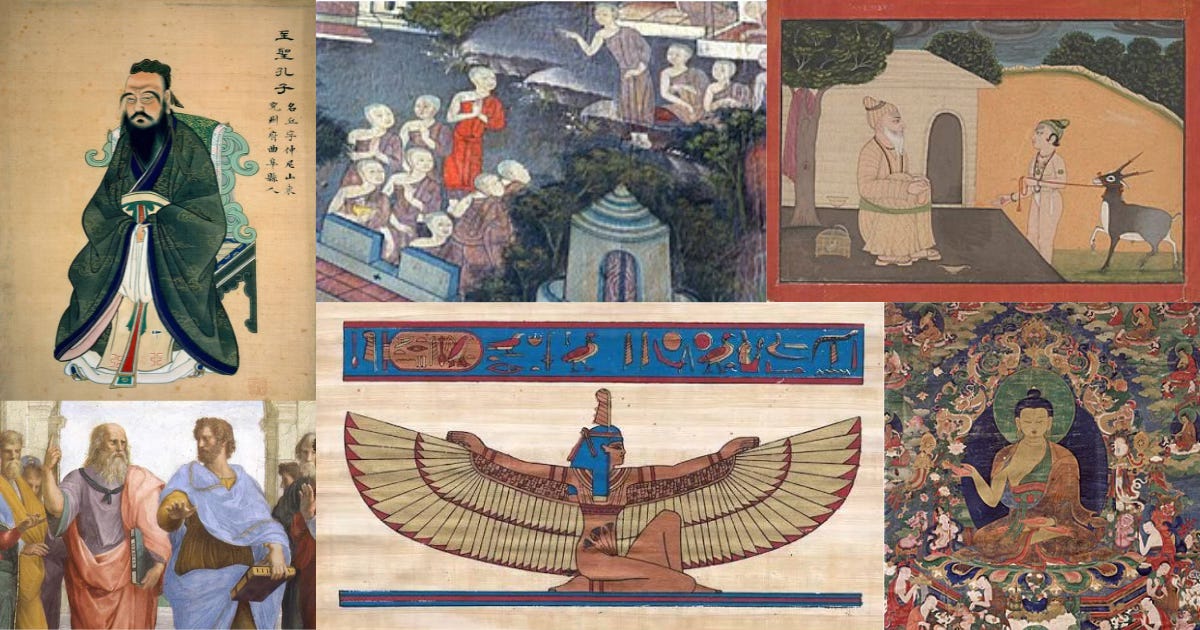
None of them had heard of each other and none of them ever would. They were separated by mountain ranges, oceans, deserts, and language.
But they were all asking the same sorts of questions: what is the good life? How should we live with one another? What is power? What can we actually know?
Karl Jaspers famously called this period the Axial Age - it’s the moment, for him, that “Man, as we know him today, came into being.”
If you’ve been here a while, you’ll know I started my self-study into philosophy after reading Sophie’s World and feeling…disappointed. This book (constantly referred to as the introduction to philosophy) was, for me, too Eurocentric and male-focused to present an adequate picture of the evolution of philosophical thought.
So when I designed my “curriculum”, it was important for me to meet non-Western and female thinkers as I work through philosophical ideas. I did this for the first phase, when exploring origin myths, I explored the Vedas, Egyptian creation accounts, the Mesopotamian Enuma Elish, and more - but then I moved to Ancient Greece to meet the Pre-Socratics and Plato.
This is the usual point where you’d move to Aristotle. To live a while in the conversation between teacher (Plato) and student (Aristotle). I’ll get there. Just not yet. Because Plato and Aristotle weren't the only thinkers of that time who ended up shaping how we think and live. Whole traditions, fully developed elsewhere, also did the same.
Over this next phase, I’ll be meeting Ptahhotep and the Egyptian concept of Ma’at (written 2000 years before Socrates even existed), Confucius (again, but this time with depth), Laozi and Zhuangzi, the Buddha, Mahavira, the women of the Upanishads (Gargi Vachaknavi and Maitreyi), and the nuns of the Therigatha.
Some of these names you may know. Several of them you may not (I certainly didn’t until I was in the thick of research) and that itself is part of the point.
The rest of this post is for members of the Studio where I look more closely at the Axial Age and ask whether we might be on the cusp of another one right now.
If you’re new here and curious about philosophy, I write weekly essays about the ideas I’m meeting in this self-directed study, and why these ancient arguments and ideas still matter - for how we think, how we live, and how we make sense of the world around us.
✨If you’re the type of reader who likes to read around something as well as through it, members of the Studio get the read, watch and listen list behind each essay✨
The Axial Age
Karl Jaspers’ The Origin and Goal of History is fast becoming my favourite non-fiction read of the year. In it, he is essentially looking for a way to think about human history without the structure of religion. It's also, weirdly, the most useful book I've read for thinking about AI, and its consequences.
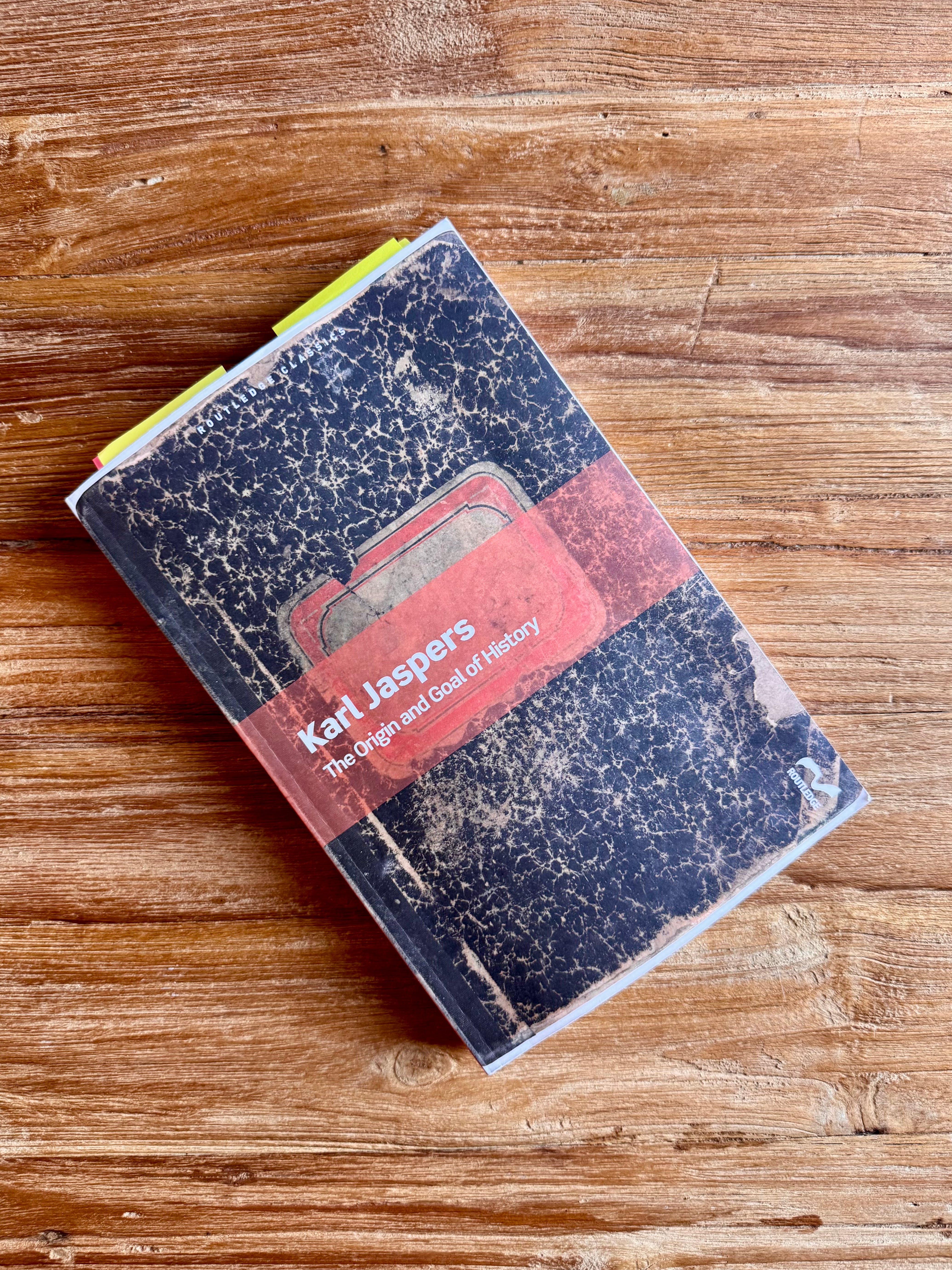
He spends the first part of the book grappling with something extraordinary. Across multiple civilisations that had no contact with each other - Greece, Israel, India, China, and to a lesser extent Persia - human beings began doing something they hadn't done before. They started reasoning about things that myth had previously explained.
