
…and we still call it democracy
Philosophy Curriculum #33: Plato's Republic Pt X - On democratic exhaustion and the demagogue's promise

What does it actually mean to live in a democracy?
In 2019, a British Prime Minister illegally shut down Parliament. A court overturned it. He won an election three months later. Today, the parties gaining fastest across Europe are the ones explicitly promising to narrow who democracy is actually for - Reform UK projected to win a majority at the next general election, the far right consolidating across France, Italy, Germany.
Across the Atlantic, the United States is now into its second month of a war with Iran that Congress never authorised. Military operations have stretched across ten countries in fourteen months - none preceded by a public case, none put to a vote.
The V-Dem Institute’s 2026 Democracy Report now lists the UK, Italy, and the United States among the countries actively autocratizing. Not sliding toward it. In it.
And we still call it democracy. All of it.
So what is the word democracy actually doing? Is it describing a system or a story we tell ourselves about a system? And if the gap between those two things has been widening for years incrementally, through moves that each looked reasonable at the time - at what point do we look back at whether we can still call the society we live in democratic?
Plato’s Republic asks the same question from a different angle: what does a democratic society do to itself, left to run its own logic, over time?
The Long Slide
By this point in The Republic, Socrates has already built his ideal city - the philosopher-kings and the noble lie all holding it together. What he now asks is: how does it fall apart?
He carefully deconstructs his ideal city through four stages showing how each collapse was almost inevitable. Each stage doesn’t arrive as a catastrophe - it arrives as the logical consequence of what the stage before it valued most.
His ideal city prizes virtue but over generations, pride in virtue becomes pride in honour. The sons of philosopher-kings stop wanting wisdom and start wanting recognition and with that, Timocracy arrives. A city governed by ambition and reputation rather than reason.
But ambition needs wealth to display itself and so gradually, money becomes the real measure of a person. Enter: Oligarchy - a city run by and for those who have, with a growing class of people below who don’t, and who are starting to notice.
That concentrated inequality starts to breed rage. Eventually the dispossessed demand their share. Democracy arrives with the promise of freedom, equality, the end of hierarchy. All desires are declared equal. Everyone gets a voice.
And this, Plato says, is where it gets complicated.
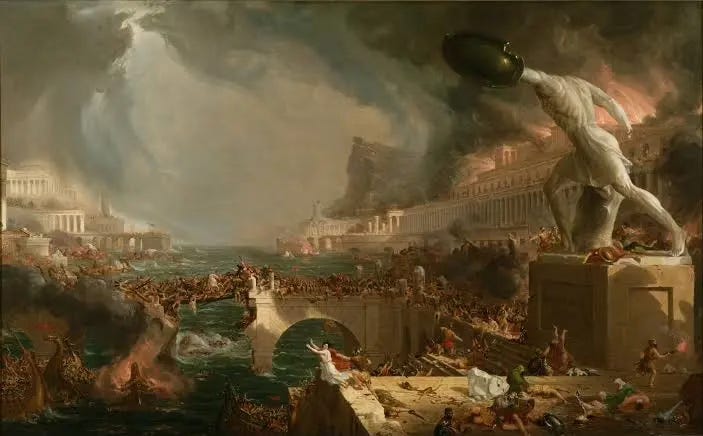
The Democratic Man
His portrait of the democratic character is - I think - the most uncomfortable passage in the whole of The Republic.
For Plato, the democratic man moves between desires without any real sense of hierarchy between them. He doesn’t discriminate between a necessary desire and a destructive one, because in a democracy that kind of discrimination starts to look like judgment. And judgment starts to look like hierarchy. And hierarchy is what democracy did away with.
It’s tempting to think Plato is being unfair here - this is the point in The Republic where his distrust of democracy starts to sound like contempt. But the discomfort of this portrait is that it doesn’t require contempt to land. It just requires honesty about what happens when a society loses any shared basis for saying that some things matter more than others. When the very act of making that distinction starts to feel like an imposition.
What Plato seems to be identifying is a freedom so total it becomes directionless. And a directionless crowd has a very specific vulnerability: it can no longer say who the enemy is, what is worth protecting, or what the story of the society actually is.
Which makes it extraordinarily susceptible to someone who can answer all three questions at once.
The rest of this post is for members of the Studio - readers who are building their intellectual life with intention.
It includes Plato’s account of how the tyrant arrives, the argument that explains why the crowd was ready for him, and this week’s read, watch, and listen list.
✨If this essay resonated with you, leaving a like helps the Studio reach more thoughtful readers ✨
The Champion Arrives
The tyrant arrives as the crowd’s champion. The one person willing to say what no one else was brave enough to name.
He tells the democratic people that the old order was corrupt, that the elite looked down on them, that the system was never built with them in mind, that he understands what they’ve lost in a way no one else does.
And he is, at first, genuinely popular - not despite the democratic chaos but because of it. He’s its answer.
Is any of this sounding familiar?
