
How to book journal
my method for staying with a book longer.

A couple of months ago I wrote about why I book journal - the cognitive case for it, really. How taking the time to write about what you read helps you hold on to the details, and sometimes even the plot (which, embarrassingly, is not a given). If you missed it, that’s the one to start with. This is the sequel.

Because today is about the how. Or rather, how I do it. There’s no single correct method here, and I want to be clear about that up front - this is me showing my working, partly so you might show me yours, and partly for anyone who’s been thinking about doing it without quite knowing where to begin.
So. Where to begin.
Before the read: the book itself
It starts, for me, with the object. I’m a spine-breaker. A margin-scribbler. The kind of reader who hands a book back looking like it’s been through something. Maybe that’s why the Kindle and I never got on…highlighting text reminds me too much of work, and that thin little progress bar doesn’t land the way actually seeing the pages does. I want to feel the ones I’ve read, the spine gone soft on one side, the unread pages still smooth and stiff.
Then, before anything else, I write two dates on the title page: the day I start, and - later - the day I finish. Until my husband finally takes the hint I have been dropping for months about an ex libris stamp, this is my version of one. It’s a small note to whoever opens the book next, probably a future me, saying: this is when you last lived in here.
During the read
There’s no science to this part, but I do two things.
The first is to annotate, underline, and dog-ear until the poor thing looks abused (although that’s not a goal I’m trying to reach, it just ends up happening). When a theme starts popping up, I flip back to that dated front page and jot it down. The tabs don’t come out yet. That comes later…
The second happens at home, in the evening. As I do most of my reading on my commute, I spend time as part of my journaling routine to write down what I made of the pages read that day.
Sometimes that’s a plain synopsis: here’s where the story got to. Sometimes it’s just me asking what on earth is going on, or what that character thinks he’s doing. And on the good days, the days I’m actually thinking, I find myself arguing. With the book, the author, with whatever I assumed a hundred pages ago and now don’t.
That arguing is when I feel like I’ve really absorbed the book. As I scribble down my thoughts I have Adler1 at the back of my mind telling me that to read a book well is to have a conversation with it. I suppose my evening journaling is that conversation.
After the read
When I finish, I add the end date to the front page, and now the tabs come out.
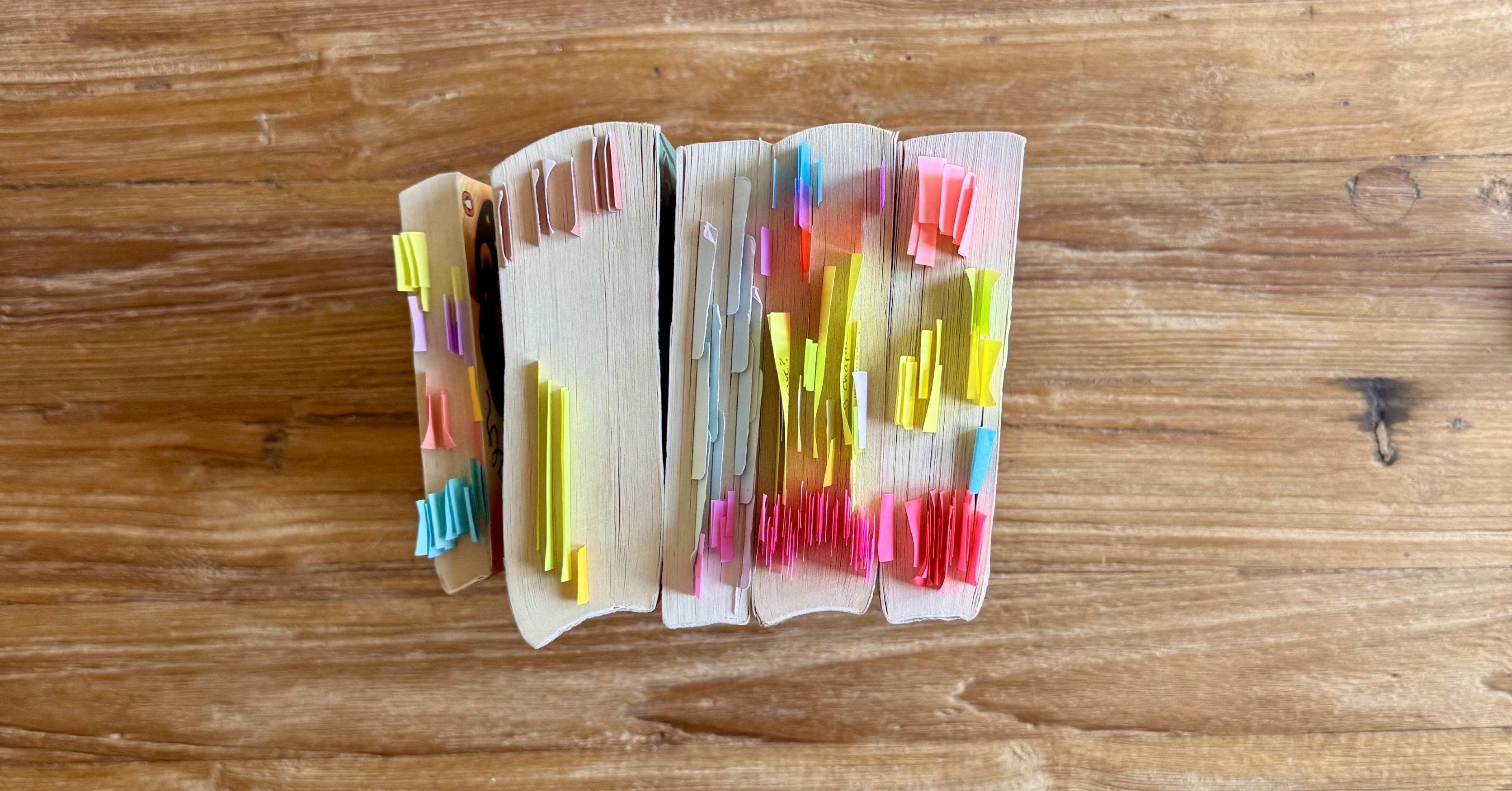
This is the sorting stage. I go looking for the themes that are ones worth tabbing up - so many of the things I write on the front page are nonsense, things that didn’t really develop so that’s why I leave the tabs until this stage. When I have a bit more intention behind it. Of course, there’s a separate tab, always, for quotes: the lines I want to carry forward into my final thoughts.
A few weeks later: the review
And then I wait. A few weeks, usually, before I go back and reread all my almost-daily notes, flipping between them and the tabbed pages, reminding myself what I once thought was worth fighting the Tube’s violent journey into the office to scrawl in a margin.
Only then do I write the review. I can’t do it straight away. If I do it comes out too emotional - a knee jerk reaction and and not enough of what I actually thought about it, or what the author was trying to get me to think about. This is why those of you who read my Book Club posts get two versions: the initial thoughts, and then the fuller one later. You’re watching me think out loud.
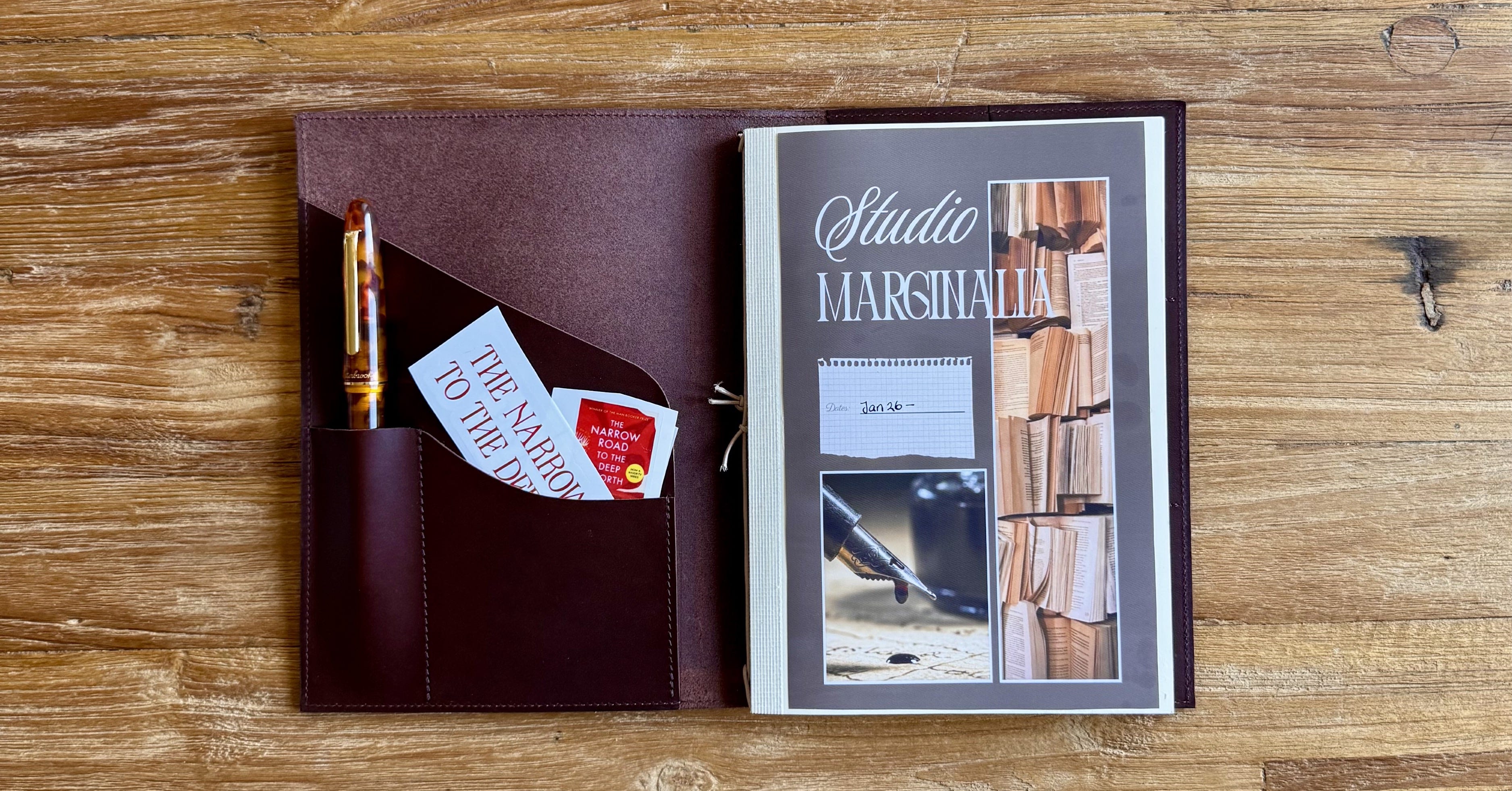
The full review lives in a separate journal. I like to keep it with a few images like the cover of the edition I read, so the record is of that book, that particular edition.
Why I bother
None of this makes me read faster, but that’s not the really goal of this. The whole exercise is designed to help me retain what I’m reading, to really understand it and in a way, to make reading less like consumption.
I’ve tried Goodreads, and I tolerate Fable for our Book Club because I enjoy talking to you guys about the chapters whilst we read it together but I never post any real reviews on books there. I find the ratings and categorisations of books off-putting, almost like I’m fighting against that categorisation rather than thinking through the book itself.
Book journaling for me is a way I can stay with a book longer. I write these thoughts for me although I haven’t yet read any of my full reviews back(!) but I hope, one day, when I have all the time in the world and I start revisiting books, I can compare my thoughts, the daily ones and the fuller ones and see what’s changed with each visit.
I’d love to know how you book journal or if you’re about to start book journaling. Let me know!
Mortimer Adler, How to Read a Book
I really like the idea of tabbing afterwards, I might give it a try! I had abandoned tabbing my books altogether for the very same reason you mention: you think something is worth tabbing so you start doing it, only to realise later on that it was irrelevant. Thanks for the idea 🙂
This was so good!!