

Can you actually control your "self"?
Philosophy Curriculum #42: On the idea that to master yourself, you first need to master the chariot

Every day is a struggle in one way or another. I don’t just mean the struggle to get on the tube at rush hour or the struggle in listening to that coworker. I mean the internal struggle I have. With myself. Every day.
Let me have another 5 mins in bed versus hating myself for being 10 mins late into the office.
Buy the journal. You know you want to. But I have plenty of journals, what would I use it for?
You get the idea.
It’s so much more complex than just head v heart, in my opinion. My internal push and pull can be an hour long debate on matters of the heart, or the head, or (let’s be really honest here) the stomach - it really doesn’t matter. And it genuinely feels, most of the time, that I am fighting two versions of myself. Two versions of my head, two versions of my heart.
And it’s exhausting. By the time I get to bed, the one decision I need to make is how quickly I’m going to fall asleep. Am I going to read that next chapter, or am I going to just let my eyes rest?
This is probably why one of my favourite allegories is Plato’s winged chariot. One of his most famous. It’s his way of describing that internal push and pull we have everyday. The soul, he says, is a chariot drawn by two horses and steered by a charioteer. One horse is noble and disciplined - guided by honour, needing no touch of the whip. The other is unruly, straining toward pleasure, the one that has to be hauled back into line. The charioteer is reason, and reason's whole job is to point the horses upward, toward truth. Let the wild horse lead and you never get there.
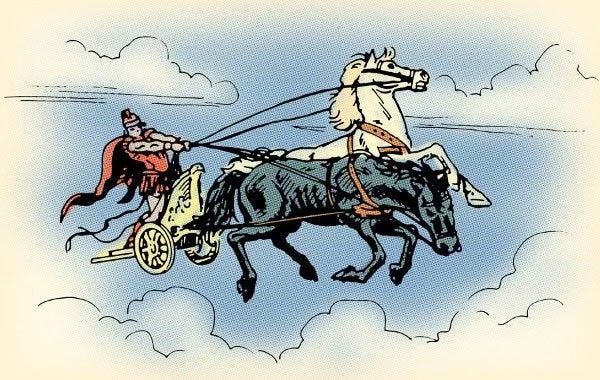
I wrote about that chariot a few months ago, when I was still in Athens with Plato. I didn't expect to meet another one when I opened the Upanishads.
But there it was, in the Katha Upanishad. A chariot again but not quite the same one. Here the body is the chariot, he senses are the horses, the mind is the reins and the intellect holds them. And the Self, Ātman, the thing I've been trying to get my head around this last month, is the passenger, the one being carried toward release - getting free of the whole cycle of wanting, and being reborn to want again.
So, of course, I had to re-read Plato’s chariot allegory and reading them side by side this week, I kept thinking how strange it was. How both cultures, thousands of miles apart, with no evidence of contact between them, reached for the very same chariot to describe the very same human struggle, at roughly the same moment in history.
Both were looking at that mess of wanting contradictory things simultaneously and both used the same chariot to explain why. There are differences between the two, but the similarity is (for me) the interesting part: both use the chariot to say the same thing - that our internal struggle can be steered, if we drive well.
How and why do two unconnected schools of philosophy, at roughly the same time, land on the same image to describe the same struggle?
And why do both end up as advice on how to live?
The rest of this post is for members of the Studio where I explore possible answers to this and share this week's read, watch and listen list.
✨ If this piece resonated with you, leaving a like helps the Studio reach more thoughtful readers ✨
