

Can we ever know our true self?
Philosophy Curriculum #39: on what the Upanishads do with that question

Can you see the self that is reading this essay?
Assuming you’re reading this on your phone or on your laptop, you can see the screen, sure. But can you see the part of yourself that is doing the seeing?
It’s not your eyes, they’re objects just as much as the screen is. I’m talking about the seeing itself.
You can’t do it, can you? Every time you try to turn inward to see the part of yourself that is seeing, or hearing, or feeling, we are just seeing objects - ears, eyes, fingers etc.
One of the central teachings of the Upanishads is this. There is a real you in there. A core you, behind your moods and the role you happen to be playing today. They call it Ātman. And no matter how hard you look for it, you will never find it.
Here’s what they mean. When you notice your hand, something just happened. There was a hand, and then there was an awareness of the hand. Someone - something - noticed. That noticing is what the Upanishads are interested in.
The thing is, we can’t see the noticing - we just see the hand. The moment we try, we’ve just done another act of noticing, and that one is also invisible. Whatever does the noticing can't itself be noticed. It's always one step ahead of us.
You can’t see the seer who does the seeing; you can’t hear the hearer who does the hearing; you can’t think of the thinker who does the thinking; and you can’t perceive the perceiver who does the perceiving. The self within all is this self of yours.
BU 3.5.2
When I first read this, my initial reaction was OK if that’s true, what do I do with that? What do you do with something you know exists - actually, not just something, the most fundamental part of you - but can't ever grasp? How can we ever know what our real self, our Ātman, is?
Instead of defining the self, the Upanishads talk about what it isn’t through a process called neti neti (roughly translated to not this, not this). There are pages of aphorisms, pithy dialogues, and long treatises all explaining what the self isn’t - I was reading them thinking, OK this is a process of elimination and at some point, I'll find out what the self is. But I never did - I was left with knowing that I can’t ever know my self.
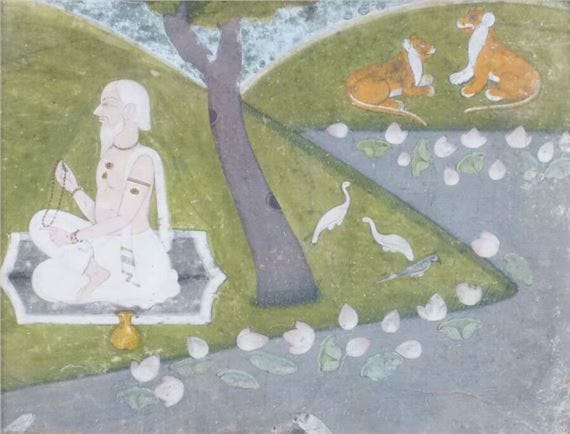
I’ve been overthinking this for weeks. Are the Upanishads saying that the suffering, heartache, joy, happiness, love - all of the things we feel - aren't happening to the real self? Because, to me, that's where this seems to land.
The journaling I do, the hours of personality tests I've endured - and let's not discount the long rambling voice notes of deep introspection sent to my nearest and dearest - all of it with the aim of trying to know myself that bit more. Are the Upanishads saying that’s futile? Every thought I’ve had about myself, however honest, is something I am looking at. None of them is the one doing the looking. So are they all for nothing?
I don't think the Upanishads are dismissing any of those things I do - I think they're saying the real self is somewhere behind all of that.
I don't know whether I find that liberating or terrifying.
The rest of this post is for members of the Studio and includes some thoughts on why I’ve found this idea harder than anything else I've read so far in this philosophy self-study.
✨ If this piece resonated with you, leaving a like helps the Studio reach more thoughtful readers ✨
